Morocco Accused of Fueling Ceuta Crisis Amid Territorial Integrity Concerns
+AI Analysis - Key Points
- 01
Morocco accused of helping to fuel the crisis in Ceuta
- 02
Spanish government sends back thousands of migrants
- 03
Tensions remain high between Spain and Morocco
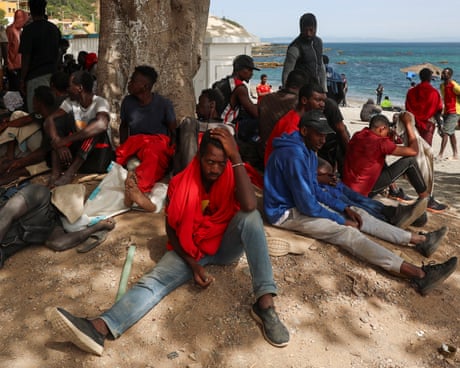
A growing chorus of voices have accused Morocco of helping to fuel the crisis in Ceuta, with the leader of the Spanish enclave describing last week’s border crossings as an attack on Spain’s territorial integrity that was seen as being “if not orchestrated, at least encouraged or permitted by Morocco”. Spain’s interior ministry said late last week that 48,300 of the roughly 50,000 people who had turned up in Ceuta, a tiny Spanish territory in north Africa, had been sent back to Morocco. The extraordinary influx had overwhelmed the city of 84,000 and set off a political crisis across the EU as some member states laid blame on Spain. In Ceuta, leaders pointed to the broader picture of what had transpired. “It’s an atrocity,” said Juan Jesús Vivas, the long-serving conservative leader of the territory. “There are 88 bodies in the morgue, and there are more on the other side of the border.” He said locals watched the events play out with a mix of sadness, worry and anguish. “People see this as not as a migration crisis; it was fundamentally an attack, a violation of Spain’s territorial integrity,” Vivas told El País newspaper. “People felt that this, if not orchestrated, was at least encouraged or permitted by Morocco.” He drew a parallel with May 2021 when Rabat loosened border controls, allowing 10,000 people to cross into Ceuta over the course of two days, during a diplomatic standoff over Madrid’s decision to allow a Western Sahara independence leader to be treated for Covid-19 in Spain. The insinuation of Moroccan involvement appeared to be backed by the preliminary assessment of Spanish intelligence services, who cited suspicions that the influx had not been planned by Moroccan authorities but concluded that Morocco had failed to stem the tide of people rushing towards the border and in some cases had even facilitated their passage. Intelligence sources told El País that the roots of the influx probably lay in a hoax that had swiftly spread across social media after a Spanish supreme court ruling that migrants arriving by sea could not be summarily deported. As the hoax gained steam online, Moroccan border surveillance dwindled to a minimum until it was completely lifted late last week, allowing tens of thousands of people to stream through. The crisis has left Ceuta reeling, with hundreds of people continuing to sleep rough on the beach or near Ceuta’s city center. The situation remains tense, with both Spain and Morocco facing criticism for their handling of the crisis.
The Spanish government has come under fire for its response to the crisis, with some critics accusing it of being too slow to act. The EU has also been criticized for its handling of the crisis, with some member states laying blame on Spain. The crisis has highlighted the complex and often fraught relationship between Spain and Morocco, with both countries facing significant challenges in managing the flow of migrants across their shared border.
As the situation in Ceuta continues to unfold, it remains to be seen how the crisis will be resolved. One thing is clear, however: the crisis has exposed deep-seated tensions between Spain and Morocco, and it will take significant effort and diplomacy to resolve the issues that have been laid bare.
VideoVideo Coverage
Morocco Accused of Fueling Ceuta Crisis Amid Territorial Integrity Concerns
Watch video coverage on YouTube
Opens relevant video results on YouTube.